
By Christopher Seminatore, Owner of GetGeofencing.com
Yes, geofencing advertising can be highly accurate for reaching audiences associated with specific businesses, properties, and events. Carefully drawn boundaries, suitable location signals, and clear timing rules help you focus advertising on relevant prospects. Accuracy varies with the device, environment, and platform, so a strong campaign pairs precise targeting with measurable results. [1][2]
For a business owner, the practical advantage is straightforward: you can select places that suggest a reason for someone to consider your offer. A furniture retailer could reach eligible devices observed at competing showrooms. An exhibitor could reconnect with an audience associated with a relevant trade show. Those are useful ways to focus a campaign around real-world context.
The important question is how well the targeting fits your goal. This guide explains what geofencing can do accurately, what affects its performance, and how to evaluate a campaign with confidence.
What accuracy means in a geofencing campaign
Several different ideas get grouped under the word “accuracy.” Separating them makes a proposal much easier to evaluate.
| Question | What you should evaluate |
|---|---|
| Is the boundary correct? | Does the mapped area fit the intended property or venue? |
| Is the location signal suitable? | Is the device observation sufficiently precise and recent? |
| Is the audience relevant? | Does visiting that location suggest interest in your offer? |
| Is the campaign producing value? | Are delivery, inquiries, visits, and business outcomes being measured appropriately? |
A neatly drawn outline answers only the first question. The quality of the observations and the business logic behind the location list matter just as much. For example, a building can be mapped correctly while serving several unrelated businesses. That address requires more consideration than a standalone showroom.
Our recommendation is to evaluate the complete campaign. A good targeting plan explains why each location belongs in the audience and what success should look like after the ads run.
How accurately can a phone determine its location?
GPS.gov gives a useful reference point: GPS-enabled smartphones are typically accurate within about a 4.9-meter, or 16-foot, radius under open sky. It also explains that buildings, trees, indoor use, and reflected signals can reduce accuracy. That is a general smartphone positioning benchmark, not a guaranteed accuracy specification for an advertising campaign. [1]
Phones can use more than satellite positioning. Apple describes Location Services as drawing on GPS, Wi-Fi, cellular networks, and Bluetooth when available and permitted. Different combinations of signals help devices estimate their position in different surroundings. [3]
The encouraging takeaway is that location technology can support meaningful distinctions between physical places. The campaign still needs to match its targeting ambition to the conditions at those places. A large, standalone property is a different assignment from two tiny shops sharing a wall.
Be cautious with a universal claim such as “accurate within three feet.” Ask what was measured, under what conditions, and whether the claim describes the boundary on a map or the observed device location.
Why a custom boundary can improve targeting
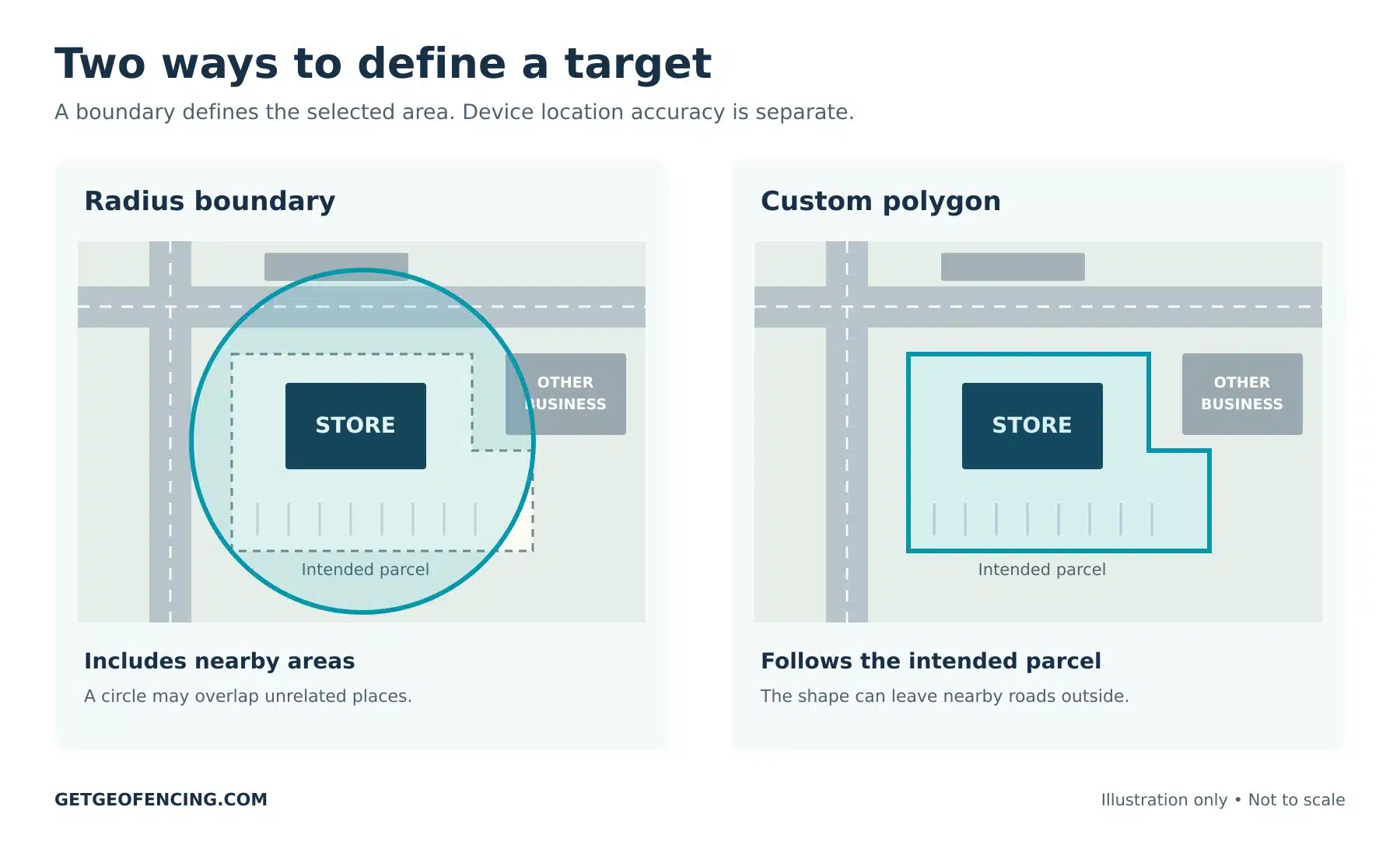
A radius draws a circle around a chosen point. A custom polygon follows a selected shape. The Media Rating Council distinguishes these point-radius and boundary approaches in its location measurement guidelines. [6]
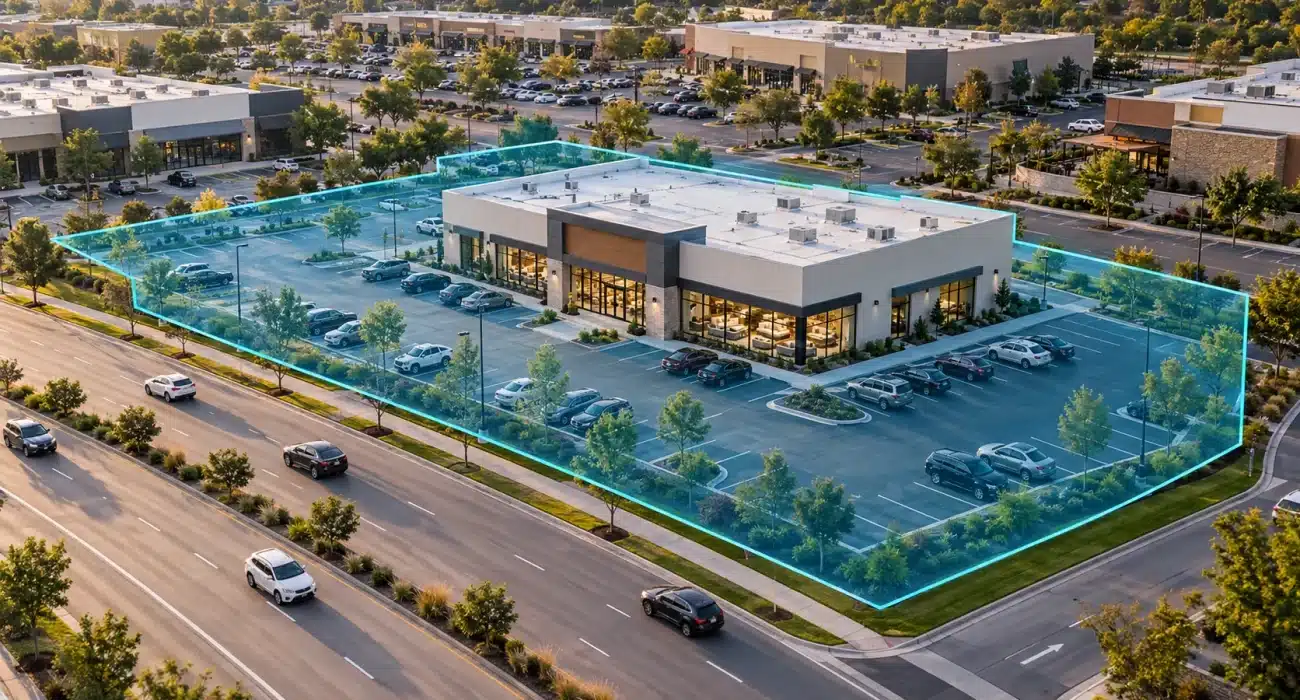
Consider a furniture showroom on a corner lot. A wide circle might include an intersection, an unrelated business, and part of a neighboring development. A carefully planned polygon can fit the showroom parcel more closely and leave those areas outside the selected boundary.
That geometric control is valuable. You can make intentional decisions about parking areas, access roads, and the edges of a property instead of accepting whatever a circle happens to cover. It improves the definition of the place you want to target; it does not change the phone's underlying location accuracy.
The right boundary also depends on your purpose. A campaign interested in shoppers entering a retail site may define its target differently from an event campaign focused on the main venue during operating hours. Start with the business question, then draw the fence.
The location signal matters as much as the map
Coordinates alone do not tell the whole story. You also want to understand where a location observation came from and how recently it was recorded.
The IAB Tech Lab's OpenRTB specification includes fields for a location's source, estimated accuracy, and the elapsed time since the location fix. It also says that a geographic area's center point, such as a ZIP code centroid, should not be passed as though it were a qualifying device coordinate. These distinctions help explain why all location data should not be treated as interchangeable. [5]
For an advertiser, the useful question is simple: “What makes this observation suitable for this campaign?” Your provider should be able to explain the approach without asking you to become a mobile engineer.
Device permissions also affect availability. Android lets users grant approximate rather than precise location access, and an app receiving approximate permission cannot simply obtain precise location instead. A campaign's audience therefore depends partly on which suitable signals are actually available. [4]
Timing makes the audience more meaningful
A location becomes more useful when paired with a relevant time window. Visiting a convention center during your industry's trade show is a different signal from visiting the building several weeks later.
Simpli.fi describes event targeting that uses selected venue boundaries and specific hours, with follow-up advertising available for up to 30 days after the event. The appropriate window depends on the campaign and the buying decision. [2]
For a short promotion, we recommend keeping the message closely connected to the offer's dates. For a product that requires comparison shopping, a longer follow-up period may give prospects time to research and respond. An expired offer should not continue running simply because the audience remains available.
Think about the sequence from the customer's perspective. What would make your message useful after that visit? A product comparison, a consultation, or a clearly explained incentive can give the location strategy a practical purpose.
Reaching an audience after a visit
Geofencing advertising can continue after someone leaves the selected area. In a published jewelry retailer case study, Simpli.fi describes building audiences around competitor storefronts and serving display ads for up to 30 days afterward. [7]
This matters when you review a campaign. The place where an eligible audience member was observed and the place where an ad is later delivered are different parts of the process. Discuss the intended delivery geography alongside the audience-building locations.
An ad also needs an available opportunity to appear. A person entering a boundary does not automatically receive a text message, notification, or guaranteed banner at that moment. Our introductory guide to how geofencing works explains the distinction between a location event and an advertising impression. [11]
For planning, ask your provider to explain audience eligibility, available inventory, budget, and frequency together. That conversation sets useful expectations about reach and avoids treating every visitor as a guaranteed recipient.

Where thoughtful setup makes the biggest difference
Some locations are easier to interpret than others. Simpli.fi identifies indoor spaces, dense urban areas, and multi-story buildings as environments where accuracy can be more challenging. Smaller fences also demand more precise signals. [8]
This gives you a practical way to improve the plan before launch. Review a downtown building with several tenants more carefully than a standalone dealership. Check whether an event shares its property with unrelated activities. Consider whether a busy road runs directly beside a proposed target.
For visit measurement, ask how the provider distinguishes a meaningful visit from momentary proximity. The Media Rating Council discusses speed, observation over time, and multi-floor considerations as relevant quality controls. Do not assume that every platform applies the same rules or that a universal dwell-time threshold is appropriate. [6]
Our recommendation is to start with locations you can explain and defend. Adding more addresses is useful only when they contribute relevant audience opportunity. A shorter, well-reasoned list can make the first campaign easier to interpret and improve.
Measuring what happened after the ad
Geofencing gives you a useful connection between digital advertising and physical places. Simpli.fi describes Conversion Zones as a way to associate an observed visit to the advertiser's location with a previous ad exposure. [12]
Keep the reporting categories clear. An impression records delivery. A click records an interaction. A submitted inquiry indicates a prospect took another step. A reported store visit is a location-based observation under the measurement method. Each answers a different question.
A reported visit also does not, by itself, establish a sale or prove that advertising caused the visit. The Media Rating Council's outcomes standards distinguish visitation from sales and address methods for estimating incrementality, including test-and-control approaches. [10]
For a local business, we recommend combining available campaign reporting with call tracking, properly configured inquiry forms, appointment requests, and CRM follow-up. Decide how you will identify a qualified lead before launch. If someone calls, your team should know which service they wanted and what happened next.
This creates a more useful conversation than a report full of clicks alone. You can discuss the audience, the response, and the changes that deserve the next round of testing.
A published example of location targeting in practice
Simpli.fi published a case study about a Florida dealership's two-week Memorial Day campaign in 2021. The strategy combined geofencing, addressable targeting, search retargeting, site retargeting, display, and connected television. It included fences around 15 nearby competitor dealerships. [9]
The case study reports 98 in-person visits and 235 online conversions, with an overall cost per action of $15.95. The online actions included searches for new and used vehicles on the dealership website. [9]
Those are provider-reported results from a combined strategy, not a GetGeofencing client result or a prediction for your campaign. They illustrate how a location strategy can be connected to specific, reported actions. They do not establish a universal geofencing accuracy percentage or isolate the effect of geofencing alone.
The useful lesson for your campaign is to define meaningful actions, track them consistently, and connect the reporting to a real business objective.
How we recommend planning your first campaign
Start with one primary objective. A retailer may want more qualified store visits. A service business may prioritize consultation requests. A trade show advertiser may want follow-up conversations with prospects. The objective should guide both the audience and the landing page.
Next, choose locations with a clear reason to be included. For each address, write a short explanation of why visitors could be relevant. Review the mapped property and identify anything nearby that could make the signal ambiguous. This simple exercise often improves the quality of the conversation before money is committed.
Then match the message to the audience. Someone comparing furniture stores should see a relevant product or reason to visit. Someone researching a service should get a clear explanation of the benefit and a straightforward next step. A relevant location cannot rescue a confusing offer.
Finally, plan the review. We recommend checking delivery, creative engagement, lead quality, and the available location reporting together. If a campaign generates inquiries that your team cannot use, investigate the targeting and offer. If people click but abandon the page, review the page and conversion process. Each finding should lead to a specific action.
A practical retail example
Imagine a furniture store preparing a 30-day campaign. This is a planning example, not a reported client result. Its objective is to generate showroom appointments for a new dining collection. The location list includes relevant competing furniture stores, with each property reviewed before launch.
The ads show the collection and invite shoppers to schedule a visit. The landing page repeats the same offer, answers basic product questions, and makes the appointment form easy to find. The sales team records which inquiries become appointments and which appointments become purchases.
During the campaign, the advertiser reviews delivery and response alongside that sales feedback. If one creative attracts interest but produces poorly matched inquiries, the next step is to refine its message. If qualified prospects abandon the form, the next step is to simplify booking.
The location strategy gives the campaign a focused starting audience. The creative, website, and follow-up then give that audience a reason and an easy way to act. That is how targeting precision becomes useful to a business.
Questions worth asking before you buy
A confident provider should welcome practical questions. Use these when reviewing a proposal:
- Can we review the actual target boundaries before launch?
- Why are these locations relevant to my prospective customers?
- How are device location quality and observation timing evaluated?
- What geographic rules apply when ads are delivered after a visit?
- How are visits defined, and what attribution window is used?
- Does reported reach represent devices, households, or estimated people?
- Which calls, forms, appointments, or sales can we track?
- What will we review during the campaign, and what can we adjust?
These questions also help you compare proposals fairly. Two campaigns with the same impression count can have different location lists, follow-up periods, creative requirements, and measurement plans. Put those details alongside the price so you understand what you are buying.
Common questions about geofencing accuracy
Can geofencing target one business?
Yes. Custom boundaries can define an individual business property. The strength of the audience signal still depends on the site's layout, available location data, and campaign rules. A shared building deserves closer review than a standalone property. [2][8]
Does geofencing identify everyone who visits?
No. Location permissions, signal availability, eligibility rules, and advertising opportunities affect who can be reached. Build expectations around the available advertising audience rather than the venue's total headcount. [3][4][11]
Is a smaller fence always better?
Not necessarily. The boundary should fit the intended place and the quality of the available signals. Making a fence extremely small does not improve the location reading itself. Choose a useful business boundary and ask how the provider validates it. [1][8]
Can geofencing show whether someone bought?
Purchase measurement requires a suitable sales or transaction data connection. A reported visit or inquiry can be useful, but neither automatically equals a sale. Choose success metrics that match the business outcome you can actually verify. [10]
Put accurate targeting to work for your business
Geofencing advertising offers a practical way to focus your message around places that matter to your customers. Its value comes from combining a well-defined audience with a useful offer, sensible timing, and a clear measurement plan.
At GetGeofencing, we can help you evaluate the locations and campaign approach that fit your objective. Bring us your service area, the places you want to consider, and the action you want prospects to take. We can discuss the targeting, creative, budget, and reporting before launch.
Request a geofencing campaign plan and see how a focused location strategy could support your next campaign.
Sources
Sources checked October 12, 2026.
- GPS.gov — GPS Accuracy
- Simpli.fi — Geo-Fencing and Event Targeting
- Apple — About privacy and Location Services
- Android Developers — Request location permissions
- IAB Tech Lab — OpenRTB 2.6, Object Geo
- Media Rating Council — Location-Based Advertising Measurement Guidelines
- Simpli.fi — National Jewelry Retailer Case Study
- Simpli.fi — Geo-Fencing Statistics Marketers Should Know
- Simpli.fi — Local Dealership Drives Online and Offline Conversions for Memorial Day Sale
- Media Rating Council — Outcomes and Data Quality Standards
- GetGeofencing — What Is Geofencing
- Simpli.fi — How Modern Marketers Reach Local Markets With Geo-Location