
Can Geofencing Target Business Addresses?
By Christopher Seminatore | September 28, 2026
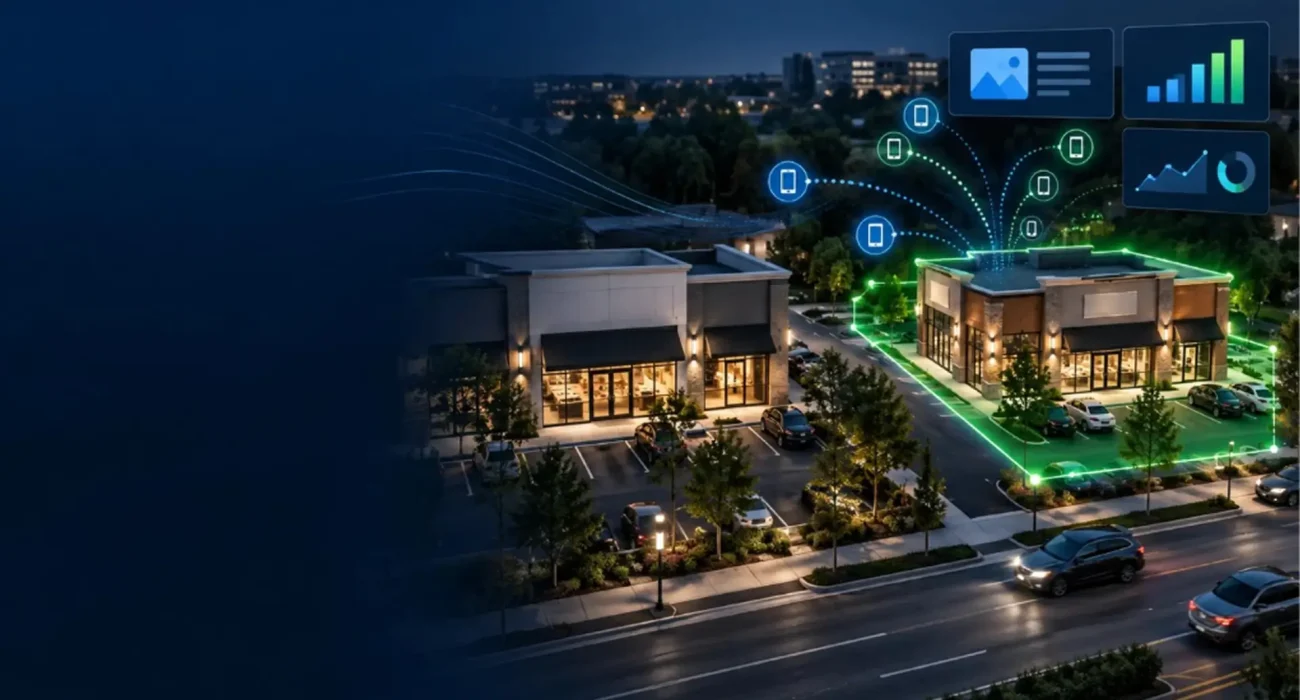
Yes. Geofencing can target business addresses, including eligible office buildings, stores, dealerships, warehouses, and competitor locations. Depending on the platform, advertisers can draw a boundary around a commercial property or use an address list to build location targets. However, targeting a workplace does not guarantee that everyone reached works there, and it does not identify individual employees.
For a business owner with a prospect list, the useful question is: which location-targeting method fits the properties, audience, and campaign goal?
Watch: Can geofencing target business addresses?
Three ways to target a business location
1. Radius targeting around an address
Radius, or proximity, targeting covers an area around a selected point. It can suit a broad trade area, such as businesses near a distribution center. It can also include neighboring properties that are unrelated to your intended audience.
Google Ads supports radius targeting with a minimum radius of 1 kilometer, approximately 0.62 miles. That is different from drawing a boundary around one building. Google also applies minimum area and audience requirements, so very small targets may have limited delivery.
2. Custom property-level geofencing
A specialized advertising platform can use custom shapes, often called polygons, around selected commercial locations. Simpli.fi describes custom boundaries for locations such as offices, retail stores, and competitor storefronts.
This approach is useful when the actual property matters more than the surrounding neighborhood. For example, a retailer could evaluate a competitor geofencing campaign around relevant stores. A precise map still does not make every location signal perfectly accurate.
3. Address-list targeting
Some platforms can turn a list of street addresses into individual property targets. Simpli.fi’s addressable advertising documentation includes businesses as well as households and describes using property-boundary data.
That makes a commercial address list a useful starting point. It does not mean every address will match, qualify, or deliver enough impressions. Review the list and mapped properties before choosing between custom geofencing and addressable geofencing.
Can you target employees at specific companies?
You can use eligible business locations to help reach a relevant workplace audience, but geofencing alone does not verify employment, job title, or purchasing authority.
An office may contain employees, contractors, delivery drivers, customers, and visitors. A shared building can contain several unrelated businesses. Remote employees may never visit the location.
For that reason, a campaign aimed at “people associated with these business locations” is more defensible than a promise to reach “every decision-maker at these companies.” If verified professional roles are essential, assess a separate professional or account-based targeting method alongside location advertising.
Example: a list of 500 business addresses
Imagine a commercial equipment supplier with 500 prospective customer locations. This is an illustrative planning example, not a campaign result.
- Clean the list. Include business name, street address, city, state, and ZIP code. Remove duplicates, closed locations, and addresses outside the service area.
- Review the properties. Separate standalone facilities from shared offices, shopping centers, and mixed-use buildings. A suite number does not guarantee suite-level targeting.
- Check eligibility and scale. Ask which locations can be activated, what audience volume is available, and whether the budget and campaign length fit that volume.
- Use a relevant offer. A maintenance assessment or product demonstration may be more useful than a generic brand message. The ad and landing page should speak to the business problem.
- Measure qualified inquiries. Track forms and calls, then use the CRM to assess company fit and sales progress. Clicks alone do not establish lead quality.
Where do the ads appear?
Depending on the campaign and available inventory, ads can appear on participating websites, mobile apps, or streaming services. They are paid media placements, not automatic text messages or notifications sent to every phone that crosses a boundary. Simpli.fi lists display, video, and connected-TV options in its addressable advertising overview.
What should you check before launching?
- Map quality: Ask to review target boundaries and adjacent properties.
- Audience limitations: Confirm how location signals qualify a device and what the platform can actually establish about that audience.
- Location eligibility: Do not assume every commercial address is suitable. Flag healthcare, schools, and other potentially sensitive locations for platform-policy review before activation.
- Delivery expectations: Ask for a realistic plan if the audience is too small. A larger address list does not automatically mean a better campaign.
- Measurement: Agree on the conversion actions, reporting cadence, and attribution limitations before spending.
Frequently asked questions
Can geofencing target a competitor’s business address?
Yes, eligible competitor locations can be used as campaign targets. Select locations that match your offer and review the property boundaries rather than assuming any nearby business is relevant.
Can it target one office suite or floor?
Do not assume it can. Shared buildings and stacked floors make it difficult to isolate one tenant using a geographic boundary. Ask the provider to explain the limitations for that specific property.
Will every employee see the ad?
No. Employment is not established by location alone, and ad delivery depends on available signals, audience eligibility, inventory, budget, and campaign settings.
Is Google Ads radius targeting the same as property-level geofencing?
No. A radius covers a circular area around a point. A custom property geofence can follow a selected footprint. Neither method guarantees perfect location accuracy.
Have a list of business addresses?
GetGeofencing can help evaluate the locations, campaign objective, ad formats, and measurement plan. Start with the business addresses you want to reach and the action you want prospects to take.
Request a business-address targeting review or learn more about our managed geofencing advertising services.
Sources reviewed September 28, 2026: Google Ads location-targeting documentation and Simpli.fi’s geofencing and addressable advertising product pages, linked above. Platform capabilities and availability can change.